on how to blend in and
not to appear too much like a tourist
in a Paris restaurant . . .
(or at least how to be a good one)
in a Paris restaurant . . .
(or at least how to be a good one)
The following is based on a book chapter that we prepared way back in 2002-2003 with a Paris friend, Barbara Pasquet-James, and updated a few times since then. (The book was designed to list non-smoking restaurants in Paris; it was going to be a thin book. But then the national smoking ban went into effect in 2008, happily making such lists obsolete.) We and others have shown this section to French friends, and many have reported back to the effect that “all visitors to France should read this.” That may be a bit much, but here goes:
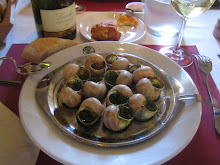
We are tourists when we visit Paris/ France, and we don't pretend otherwise. But, like most other tourists, we try to respect the local culture, and not stand out too much. At the risk of sounding a bit preachy, we’ve set out, like a good plateau of oysters or escargots, a dozen tips and observations collected from numerous sources and from personal experience — tips that may make Parisians more likely to appreciate you, and you them.
First — And especially for dinner in a restaurant or serious bistro: Make a reservation
Reservations are not necessary or even customary for cafés, or for many brasseries (except at peak hours), but may be necessary for many “serious” restaurants and bistros. Moreover, making a reservation exhibits respect, and ensures that you won't be disappointed if your chosen restaurant or bistro is overbooked. When you don’t reserve by phone (see accompanying box), you might do what we often do: walk around during the day to scope out a place where you’d like to dine. Enter, deliver a solid “bonjour monsieur” (or madame), take a look around, shake hands/ introduce yourselves, and then make a reservation for that evening or the next. As you leave, take the restaurant’s business card, and write the reservation date and time on it. When you later return to the restaurant, you will do so with the authority of someone who at least knows where he or she is going.
[Reserving by phone: If your French is poor, ask your hotel receptionist to reserve for you. More challenging and more fun, if your French is passable, telephone and make the reservation yourself. But don’t be too surprised when, after your carefully planned but bumbling phone request, questions are thrown back at you in a rapid-fire fashion. Be prepared to recite your full telephone number when prompted to do so.]
Second — Saying “bonjour monsieur” or “bonjour madame” to all restaurant personnel you meet will ease your way considerably
This was mentioned before, and cannot be stressed enough. At first it may feel a bit odd, but it’s a deeply ingrained social custom, and if you don’t do it, you stand out, and worse, appear to be rude. Don’t hesitate to say “bonjour” 24 hours a day; it translates as “hello,” not “good day.” You can, if you wish, substitute “bonsoir” if it’s after 6:00 p.m. (Do not say “bonne nuit” unless you are in your nightgown and are immediately about to hit the sack.)
[Rudeness?: The commonly held belief of some tourists — that the French in general, or Parisians in particular, are rude — often stems from the failure to utter the simple greeting, “bonjour madam/ monsieur” or to observe other similar social customs (such as remembering to use the expressions, pardon, excusez-moi, and s’il vous plaît). These utterances are a reflex for the French, and if you fail to do the same you may quite unintentionally trigger a less than cordial response. So, “bonjour” and “s’il vous plaît” your hotel receptionist, bus driver, and ticket taker, as well as your waiter. And please make sure to include the word “monsieur” or “madame” after your bonjours and other similar expressions.]
On the whole, the French are formal and polite, but don’t confuse that sing-songy, ubiquitous little “bonjour” as a sign of genuine friendliness. It may be — but more often than not, it’s just part of the expected way of acknowledging the presence of another. So jump in and do the same; give your waiter a healthy “bonjour.” He’ll respond in kind, delivered with a courteous and professional air, and rarely with a smile. The absence of ready smiles must not be taken personally — most local customers don’t receive (or give) them either. The French (except, perhaps, those in the south) ration their smiles carefully. What you are more likely to get from your waiter is good-natured guff. He may test your mettle to see what you can take. Push back in a friendly and confident manner, and you will gain his respect, thus creating an experience that will be all the more enjoyable.
[A waiter is not “garçon”: If, during your meal, you want to attract the waiter’s attention, do so by subtle eye contact, or say “monsieur, s’il vous plaît” as he passes. Despite what you may have seen in old films, or heard from your great-uncle Bob, who was stationed in Paris and recounts many fine restaurant experiences from the 1950s-1960s (probably dives), never call a waiter “garçon” (boy). In France, many waiters are serious professionals. Some locals may get away with “garçon,” but not us, and not you.]
Third — Dress, indoor voice volume, and dogs
Dress has changed in the last ten years. The first version of this post read: "Swooshy athletic shoes, baseball hats, gaudy tee-shirts, or shorts of any kind are not apt to warm a waiter’s or le patron’s heart, and they will (whether they notice or not) cause at least some local customers to roll their eyes." Now we see hipsters in blingy athletic shoes of all kinds, often with bright laces; and well dressed folks in rather ironic Converse All Stars. We see lots of tee-shirts, plain, gaudy, or just base. Even baseball caps are not unusual, although they are rarely kept on inside. Thankfully, what has not changed is scarves — both for men and women, and worn all year (amusingly, even on warm days, and inside). No matter how you are dressed, you will know that you’ve succeeded in blending in when, on your way to dinner, a Parisian stops you on the street to ask you directions, or for the time — possibly the only two permissible questions to ask strangers in public places, by the way.
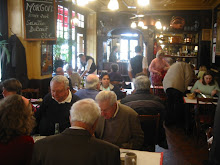
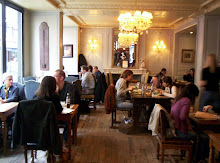
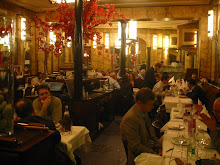
The pleasant ambient murmur of local voices in a Paris restaurant is considerably lower in volume than in most American restaurants. The French easily achieve privacy and intimacy in crowded restaurants, many of which have very closely placed tables, by speaking softly. Depending on the place, speaking or laughing too loudly can be viewed as an intrusion on other patrons’ dining pleasure.
Dogs: Here is another thing that has changed in the last ten years. We used to enjoy seeing all kinds inside restaurants, but there have been fewer lately. And yet we've been told that there are more canines in Paris than children.
Fourth — Expect to stay a while
A typical restaurant lunch or dinner is three courses: an entrée (that’s a starter, not the main course), a plat principal (that's the main dish), and a dessert. One of the beautiful things about traditional French dining is that it is a leisurely ritual, a time for conversation and reflection, and not just a fueling stop. On top of that, realize that food and dining is a well-known French obsession. Mealtime is often the most important, and enjoyable, part of the day, and the French have no desire to truncate the experience. So count on approximately one and-a-half to two hours for lunch, and two-and-a half to three hours for dinner. (Café or brasserie dining is less structured — see accompanying box.)
[Cafés and brasseries: These less formal establishments are especially handy for off-hours dining. One is not expected to order the traditional three-course menu. A coffee or snack consumed standing at le zinc (a.k.a. le comptoir — the counter) of a café/bar will cost less than if you order the same at an interior table. The cost is highest if your table is in the café’s prime territoire, the terrace. It’s perfectly acceptable to nurse your coffee or beer for hours as you watch the world go by and read your folded Le Monde or International Herald Tribune — or, perhaps less elegantly, as you peruse either on your iPhone.]
Although the dining experience is destined to be leisurely and drawn out, the ordering process is not. The establishment’s carte, listing its offerings, is, by law, posted outside the front door. This provides time to preview the menu and take out your Marling Menu Master in order to translate unfamiliar terms. (Most recently we've downloaded Patricia Wells' excellent Glossary onto our iPhone, where we now have it available, without needing access to the internet, on our "favorites" on dropbox.com — all of this is free.) Parisians usually don’t take a long time to order after being seated — they’ve probably eaten there before, several times, and know exactly what they want — and your waiter may become frustrated if you have to keep asking for multiple translations of items or yet another “deux minutes, s’il vous plaît.” On the other hand, if you’re really having difficulty (either deciphering the carte, or simply deciding), you can buy time by ordering an apéritif, or some wine.
Fifth — Forge ahead and speak your faulty French, and be careful with your hands
More often than not, waiters appreciate the fact that you’re making an effort. Whatever you do, never begin by speaking English first. (The same applies at hotel reception desks and shops.) If necessary, follow your “bonjour” or “bonsoir madame/monsieur” with a hopeful look and slightly apologetic, “Parlez-vous anglais?” The answer probably will be “Yes”; if not, the waiter likely will try to fetch someone who does; and if that fails, well, you are in France after all — wing it.
Be careful with sign language. If you attempt to underscore your order of “deux” glasses of vin blanc by the typical American convention of making a “V” with your middle and index fingers, you may well get three glasses instead of two: the French count on their hands starting with the thumb, not with the index finger. So for the sign for “two,” hold up only your thumb and index finger. While on the subject of hands, we've noticed that most keep them on or above the table at all times.
Sixth — Order wine and a bottled water, or a carafe of tap water
In 1825, Brillat-Savarin (in La physiologie du goût — The Physiology of Taste), said “Un bon repas favorise la conversation; un bon vin lui donne l’esprit”: A good meal encourages conversation; a good wine makes it spirited. In Paris today, this generally remains as true and guiding a principle as it was 175 years ago.
Normalement, the house rouge or blanc (both widely served by the glass, or in various-sized carafes) is just fine, and usually a bargain. If a tasting of wines selected fro each course is offered, we almost always go with that. Otherwise, order from the carte de vins (wine list). Except for upper range multi-star restaurants with extensive caves and sometimes sommeliers, most restaurants offer a range of bottled wines at prices substantially lower than the often outrageous prices found on most American restaurant lists. Impress your waiter, and benefit your pocketbook, by staying away from the easy selections like Bordeaux (made from cabernet sauvignon and merlot) and white Bourgogne blanc (chardonnay) or rouge (pinot noir — which can be otherworldly, but is often expensive and disappointing for those looking for, or used to, New World fruit bombs). There will usually be a côtes-du-Rhône on the list (made from grenache, syrah, carignon, cinsaut, and mourvèdre, in the southern Rhône valley). Or, order a lesser-known and more characteristic regional wine. (See accompanying box.)
[Red wines: Try a Chinon or Bourgeuil (made from cabernet franc, in the Loire Valley); a distinctive poulsard or trousseau from the Jura; côtes-du-Rhône (made from grenache, syrah, carignon, cinsaut, and mourvèdre, in the southern Rhône valley); a dark and cool Cahors (made from malbec, a.k.a Auxerrois, near the river Lot in the southwest); a Gaillac (made from rare indigenous varietals such as duras and brocol, and other more common varietals such as cabernet franc and merlot, in the southwest’s Tarn département); an appellation-designated Beaujolais (made from gamay, in southern Bourgogne (Burgundy), just above Lyon); a or a pleasant and light pinot noir from the Sancerre region. White and rosé wines: Try a true dry riesling or pinot blanc from Alsace; a dramatic oxidative ("sous voile") savignan from the Jura; a chasselas from the high alps of the Haute-Savoie near Lake Geneva; or chenin blanc, or bone-dry muscadet (perfect with fresh shellfish), both from the Loire. A dry Cassis or a Bandol rosé from coastal Provence is always a beautiful and reliable choice.]
Bottled waters — eau minérale — present a choice between eau avec gaz (a.k.a. gazeuse, carbonated water) and eau nature (or “sans gaz,” “non-gazeuse,” or plate i.e., “flat” or still water). In the most recent ten years, many restaurants have taken to filtering and bottling their own, of both types — a good trend. But absent that, in the first category, a good choice is the French brand Badoit — it has light bubbles that go well with food, and it’s easy to pronounce (“bad-wah”). Similar to Badoit, and perhaps a bit finer, is Chateldon, from the Auvergne region. (You may, however, be offered instead an Italian water, San Pelegrino, the gazeuse that’s showing up in many Paris restaurants.) For non-carbonated bottled water, order Vittel, Contrex, or Evian. It’s perfectly acceptable, and safe, alternatively or additionally, to order tap water (eau du robinet), which will come in a carafe (ask for “une carafe d’eau” or if you want it cold, “bien fraîche”). Ice water is rarely served, but if you need it, ask for eau glacée, or glaçons (ice cubes).
Asking for “une bière” gets you bottled beer; requesting “un demi-bière” is tap beer. Neither is traditionally served at dinner, except in brasseries. It is not customary to order a soft or cola drink with dinner.
Seventh — Understand the difference between “le menu” and “la carte,” and be careful about splitting
La carte is the written listing of what the establishment serves. Le menu, by contrast, which may be called the formule, is a combo meal: first course (entrée), second course (plat principal) and sometimes dessert, offered as a package for a set price (le menu fixe), and often the best deal in the house (although the mode now in Paris is a choice between entrée and plat principal or a plat principal and dessert, for one price). In Paris, or a city, le menu may offer a couple choices for each course. But in the countryside, le menu might be a fixed deal with no choices for each course. So, if you are asked if you want “le menu,” and you answer “oui,” you have just ordered the two or three-course offering of the day! Unless you want to do that, make sure you get, and order from, the carte. (Substitutions are seldom allowed when ordering le menu, unless, of course, the menu offers options in the first place.)
In nicer places, more than one menu will be offered — there may be a tasting menu (menu de dégustation) or a gourmet menu (menu gastronomique), or both. These menus, designed to show off the chef’s specialties and creative powers, may be more pricey. When dining as a couple, it’s fun to order one regular menu and one of the specialty menus, so as to sample a broader range of the establishment’s offerings.
Finally, regarding splitting dishes: If you order from the carte, splitting a starter (entrée), cheese, or dessert is usually quite acceptable. Ask for "deux cuillères" — two spoons. Splitting a plat (main course) can be quite problematic, but an appropriate smile and a good attitude will take you far. You can usually split a plat (or even an entire single "menu") with no worry when sitting at the bar — if the place has one; that can come in handy if you’ve had a huge lunch earlier in the day.
[It also used to be difficult to split a bill: Until a few years ago, waiters often refused to make out “separate checks.” But in the past few years, splitting — by giving your waiter two or more credit cards to evenly divide the bill — has become more commonplace.]
Eighth — Sit back and let your taste buds be “amused” — and don’t expect salad with, or before, your main course
If you are in an upscale place that has (or has sights on) a Michelin star, you’ll likely be started with a complimentary gift from the kitchen, an amuse-bouche or an amuse-gueule — a bite-sized savory, a canapé, designed to whet the appetite or “amuse” your mouth and taste buds.
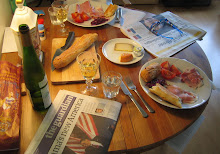
In lesser places (for us, most of the time), you’ll be quite content with the basket of freshly cut bread, often a baguette, but sometimes a specialty loaf or combination of breads. Beurre (butter) is not commonly served except on request. Often (and always, in a café or brasserie), a strong Dijon mustard will be on the table. If it isn’t, ask for it. A nice dab is meant to be spooned onto the side of the plate to be eaten with meats.
[Salads: If a salade verte (green salad) is desired, order it when you receive your plat principal, and it will be served after completion of that course. (A simple green salad is almost always available, even though not listed on the carte. Just ask for it. We've been refuseed only once in 15 years.) Other, more substantial salads that include meats, cheeses, and nuts, etc., will be listed on the carte, as entrées or as complete meals. Small green salads are served along with quiche, or fish, but only as an accompaniment, not a separate course, and never as a first course.]
Finally, look at the entire experience as an opportunity to be adventurous. The French have learned to make good use of many animal parts that, in other countries, are consumed unknowingly and only in sausages and other lesser forms of tubular foods. Sometimes it’s best not to use a menu translator, and just enjoy what you are offered, knowing that if it’s being served, you can rest assured that millions of French folks have given it their blessing.
[“Doggy bags”: The French love their dogs, but until recently they have not asked to take home left-over portions of meals, either for their pooches or for themselves. It used to be that if you asked to pack up part of your meal, you'd get a raised eyebrow, and be told you are not in a take-away establishment. But this is changing; we've seen French neighbors ask for a bag to take home, and we've done it ourselves once or twice. Another very cultured friend of ours carries ziplock bags in her purse, for extremely discrete use . . . .]
Ninth — Did someone say cheese?
Just when you think you’ve done well and have earned your dessert, you learn that, for the real heroes at your table, there’s an optional additional course: le fromage. Some regard this part of the meal as a reward. The cheese cart or plateau (tray) will be brought to your table. “Would you like some regional cheeses?” Although the cart may have twenty offerings, you are expected to select only three, possibly four. Depending on the establishment and your waiter, the portions that will be cut for you after you point out your choices may be enormous or they may be minuscule. Monitor and adjust your order accordingly. At this stage of the meal, we typically order only one serving, which we split between us.
If the cheese that you select is presented to you in a wedge, eat it by cutting along the side of the wedge — don’t chop off the “nose.” (This convention applies when you are sharing a single wedge with others; because the cheese is best at that center area, it's considered rude to hog that part.) More bread will be brought for the cheese course (and sometimes butter as well), but make sure that you have sufficient wine to drink with the cheese. If you’ve miscalculated and have run out of wine at this point, don’t be surprised if (as once happened to friends we were dining with) a nearby customer intervenes and tells you that you cannot possibly enjoy the cheese without wine. And he will be correct: wine, at this stage, is essential: it cuts the richness of the fromage and, aficionados point out, must be sipped while the cheese is in the mouth. So order another glass, and, as you enjoy your vacherin des bauges, bleu de termignon, or cantal, consider skipping the dessert.
[Fruit course: Sometimes a fresh fruit course (complete with cutlery for peeling, etc.) will be offered after, or in lieu of, the cheese course.]
Tenth — Dessert, and, finally . . . le café
If you’ve taken the cheese course, and now feel that you should pass on dessert, you will be excused. But if you’ve ordered a menu that provides a dessert with your meal, you might as well partake. Standards to look for are babas au rhum (small leavened dough cakes soaked in rum-flavored syrup), crème brulée, various crêpes, and profiteroles au chocolat (small custard-filled cream puffs with chocolate sauce). Keep an eye out for the house chocolate cake — a sinful dark concoction often served with a vanilla-y crème anglaise.
Not until (or in some cases after) the dessert course (or, after the cheese course, if you skip dessert) are you allowed to have coffee. If you ask for coffee before dessert, your waiter likely will hold the order until you have finished the main part of your meal. And even then, if you order the wrong style of coffee for the time of day, your waiter may not bring it at all: cappuccino and other any coffees with milk or cream (like café au lait) are reserved for breakfast or served only in the afternoon. Not only will asking for one after dinner blow your cover, but the creaminess of the coffee will mask and spoil everything that went before.
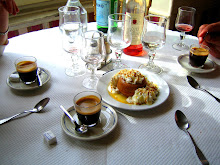
Whether labeled café, café espresso, or café express, these terms all mean one thing: strong espresso, served in a small saucered cup with a tiny spoon for stirring in sugar. If you want something like “American” coffee, ask for café allongé — and you will be brought a large cup of lighter coffee elongated with water. (The other, less traditional, and more patronizing term for this is “café américan.”) Black coffee is café nature. Coffee with cream is café crème. Decaffeinated coffee is a “déca,” or café sans caféine, and is widely available. In upscale places, chocolate truffles, mini-madeleines or other sweets may appear when the coffee is brought out, and are a complimentary, elegant touch.
[The noisette: If you’re dying for an after-dinner café crème fix no matter what, try a café noisette (simply “une noisette” to locals and those in the know). It’s an espresso served in a small cup with a dash of cream added. Sometimes the cream is served on the side. Those familiar with Spain will instantly recognize it as a café cortado.]
Eleventh — The digestif
After a three hour meal, you may find yourself a bit overly sated. When a waiter overheard us discussing this condition one evening, he advised us to have a digestif, one of France’s most noble inventions. These after-dinner liqueurs — Cognac, Armagnac (brandy), Calvados (made from apples from Normandy), Porto, or an eau-de-vie (various clear fruit spirits), among many others — are said to stimulate digestion. “Oh sure,” we thought, just what we need after a substantial dinner and numerous glasses of wine. But he was right. We don’t do it often but every once-in-a-while, a good digestif is just the ticket.
Twelfth — Pay, tip (or not), and depart in style
In some places, if you don’t ask for the bill (“l’addition, s’il vous plaît”), you may sit there for an hour before it finally arrives. It is considered rude to present the tab without being requested to do so. (In fact, the table will not even be cleared of your empty glasses; to do so would suggest that you should leave.)
When your accounting finally is presented, know that unlike in some countries (including the United States), where waiters depend on tips, in France, the waiter’s payment for “service” is almost always incorporated into the grand total. (The bottom of the carte will state “service compris” — service included.) Does this mean you shouldn’t tip? Not necessarily. . . . (See accompanying box.)
[Tipping: We have been repeatedly told that most Parisians don’t leave a tip on top of the grand total. Others insist it’s customary — but only "pièces jaunes," small change. Some guidebooks authoritatively recommend leaving an additional five to ten percent. From our experience, this is not done. We leave just a euro or two up to five, if the service was especially good. (Doing so can be — but is not always — in your best interest if there’s a chance you’ll soon return soon.) Also, or alternatively, you might ask your waiter to convey to the chef that you enjoyed the meal. (If you pay by credit card, always provide any small tip in cash — but just leave it, don’t hand it to your waiter).]
Finally, if you’ve enjoyed your dining experience, let the waiter and host know, and when you stand to depart, take the restaurant’s business card, shake hands, and say “au revoir” (followed, of course, by “monsieur” or “madame”). If you return within a few days, your follow-up visit may be even better.
If you happen to be staying in a hotel or apartment in the vicinity of the restaurant, you may, as we do, prefer to walk back “home.” The amble aids digestion as we discuss the evening, observe the city at night, and prepare for the next day — when it’s time to start over.
[The long walk home: After a long, late dinner, we find a kinship with the observation of A.J. Liebling, who wrote: “Pedestrianism was always my balance for voracity; they were countervailing joys. Walking, I consumed what I had eaten, built up an appetite for more, had noble thoughts, and spotted likely-looking restaurants.” (Between Meals — An Appetite for Paris (1959).)]




















.jpg)






.JPG)




.jpg)
14 comments:
Hi, hope the tips really work properly...
cheers,
suma
-------------------------------------------
http://www.gourmet-chocolates.org/
Your clear and succinct tips for a satisfying dining experience in Paris and other parts of France should be very helpful to people who are making a concerted effort to get the very most from both their dining experience and their comparative culture education.
Bravo! on all your hard work in putting the article together.
That was a great read and I agree, should be compulsory for visitors to France.
Re the "bonjour", we needed to go to a doctor's surgery on one trip, only to be greeted by every person in the waiting room when we arrived. How different from home experiences.
Hello Lynn and Nick,
Thanks for the comment. "Bonjour" in the doctor's waiting room, indeed! By the way, I very much enjoy your respecive blogs, as well as the comments/ posts that both of you make on the Tripadvisor France Forum.
Jake
Great list! Thank you very much for sharing it. You've saved me hours of work and probably explained it much better than I ever could have. I'll be passing this along to my friends and family who will be visiting me next month.
Thanks, Amy. (We are in Paris right now, putting our tips to good use, and collecting new ones. Tonight, Chez Rene, in the 5eme.) Jake
Which came first, the chicken or my blog?
http://parisrestaurantreviewsandbeyond.blogspot.com/
Hello Mortstiff,
I’m not sure — I finally put the original version of this site on line in August 2007, and so perhaps the answer is, “chicken.” (I’d like to think of myself as a nice Crèvecœur, from Normandy.) In any event, beyond a common word (I think that “Paris” doesn’t count), I must say that your site’s excellent and lively restaurant reviews are plainly superior. You are giving John Talbott some competition. So, I’m very glad to learn of your site, and we’ll be following it from now on . . . .
Jake
Thanks for your kind remarks and I'm glad you didn't take my comment the wrong way. Glad to discover your site.
Hello Mortstiff,
When I have time I'm going to add your site to our restaurant blog listing in our "Geneal Notes" section, etc. But in the meantime, I'll mention a place where we dined last month slightly "beyond" Paris (and only 35 minutes from CDG), in Montmorency: “Au Coeur de la Foret” http://www.aucoeurdelaforet.com/Visite.htm
Great rotisserie, among other things. And the proprieteres are delightful. You may like it . . . .
Always up for suggestions and another venture into the beyond.
Enjoyed the article, lots of good hints. I have a question. My son has celiac disease and cannot eat any wheat. When would it be appropriate to ask about what foods are available that he can eat: before we're seated, as we place our order, or another time? Would it be considered appropriate to ask to speak with the chef? we don't want to appear rude, but it is important that he get appropriate foods.
Hello annonymus,
Thanks for the comment. When to bring up the celiac disease issue? First, you may be able to get some idea before you even go inside — by reading the posted carte (written menu) outside. In any event, I’d mention this to your waiter (nicely of course, and after a solid “bonjour monsieur/ madame”) as soon as possible after you are seated and handed the carte. I assume your French is good? If not — and just to be sure — I’d also want to have it written in very clear French on a piece of paper that you can hand to the waiter, and ask him/ her to confirm this with the chef. Regarding speaking directly to the chef — I doubt that will be “do-able” in most places, but it may be possible in some.
I’m also thinking that if I were you I’d post this question on the Paris/France forum of Chowhound (http://chowhound.chow.com/boards/49 ) and/or Tripadvisor (http://www.tripadvisor.com/ShowForum-g187070-i12-France.html ) — I suspect that you are bound to get some useful responses.
Jake
Nice Article
Post a Comment